
The Ultimate Piano Guide: Everything You Need to Know Before You Start Playing
The Ultimate Piano Guide: Everything You Need to Know Before You Start Playing
 UCMA
Reading time: 11 minutes
So you want to learn piano. Here’s the good news: you don’t need years of practice before you play something real.
This guide walks you through the big decisions first—picking between a piano and a keyboard, comparing ways to learn, and knowing what to expect along the way.
Think of it as your starting point, not a deep dive into every detail. Wherever you need more depth, we’ll point you to a guide built just for that step.
Table of Contents
Highlights
- Pianos, digital pianos, and keyboards aren’t the same instrument—your choice affects how fast you improve.
- You don’t need years of lessons before you play real songs.
- Self-teaching, private lessons, and group classes all work—the right pick depends on your goals.
- Short, daily practice beats one long session a week.
- It’s never too late to start; adult brains still adapt to new instruments.
What Does It Actually Take to Learn Piano?
A lot of people believe piano takes years before you can play anything fun. That’s just not true.
Three things matter most: the right instrument, a habit you can actually stick to, and a method that fits your life.
Skip the right instrument, and you’ll spend more time fighting your gear than making music. Skip a method that fits your schedule, and even great gear ends up gathering dust.
We’ll cover practice habits later in this guide, and go even deeper in a dedicated post. For now, let’s start with who this page is for.

Who This Guide Is For
- Complete beginners who don’t know where to start
- Adults picking up piano for the first time
- Parents researching lessons for their kids
- Self-taught players deciding between apps and a real teacher
Wherever you fall on that list, the next section covers the first real decision you’ll need to make: what you’re actually going to play on.
Piano vs. Keyboard: Which One Should You Learn On?
This is the one decision most guides skim past—so let’s actually walk through it.
Acoustic, Digital, or Keyboard? Here’s the Real Difference
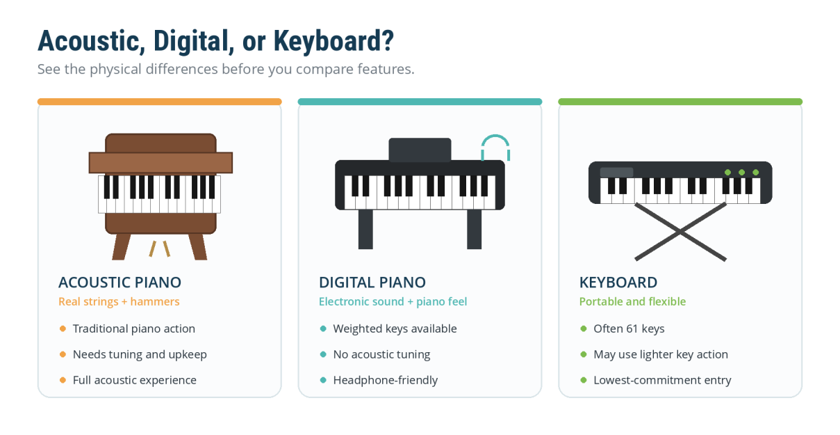
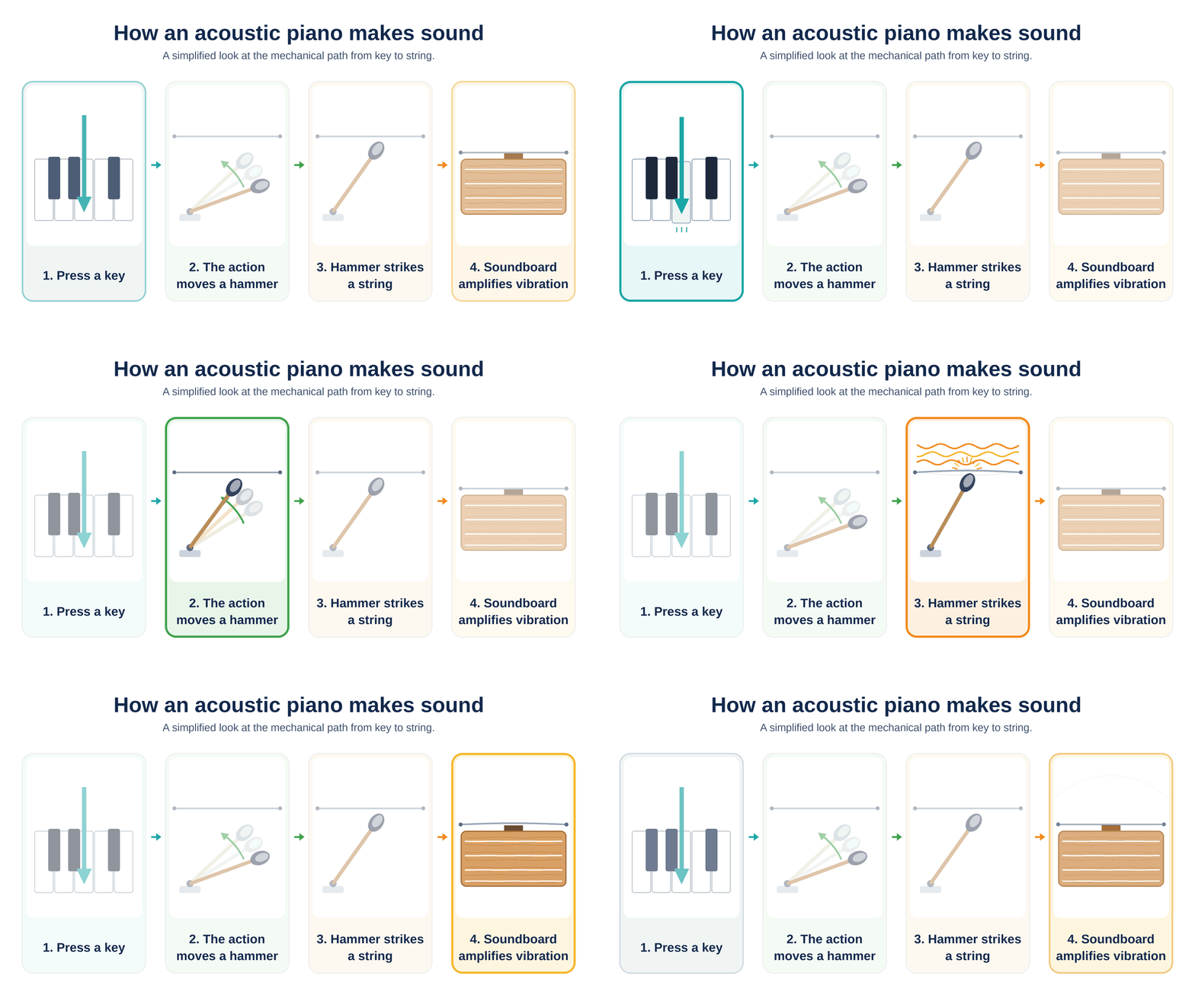
An acoustic piano makes sound the old-fashioned way: hammers striking real strings inside a wooden frame. That mechanical setup is exactly why it needs upkeep.
According to the Piano Technicians Guild, a well-maintained acoustic piano typically needs tuning once or twice a year. A brand-new piano often needs it more often in its first year, since the strings are still settling.
A digital piano copies that same weighted feel through samples and electronics instead of strings. It doesn’t need the physical tuning an acoustic piano requires, and it costs far less to maintain over time—though its internal pitch reference can occasionally drift or get bumped out of place, which is a quick software fix rather than a real tuning job.
A keyboard is the lightest and most portable of the three. Many keyboard models use unweighted keys, which feel noticeably different from a real piano under your fingers.
None of these three options is objectively “best.” They’re built for different situations, and the right pick depends entirely on what you’re trying to do.
People throw around “keyboard” and “piano” like they mean the same thing, but for a learner, they don’t. Touch and key weight shape how your technique develops, so the instrument you start on actually matters.
For a closer look at acoustic options, request the Steinway & Sons Piano Buyer’s Guide through Steinway Piano Gallery Fresno for more on grand versus upright designs, style, finish, and touch.
Which One Should a Beginner Choose?
There’s no single right answer here. It comes down to your budget, your space, and how committed you already feel.
Not sure you’ll stick with it?
Start with a basic 61-key keyboard – it’s the lowest-commitment entry point, and a weighted version is a nice upgrade if your budget allows.
Ready to commit from day one?
Get an 88-key digital piano with weighted, hammer-action keys.
Want the real thing and have the budget for it?
Go acoustic – you’ll also get better resale value down the line. For families in Fresno and nearby, Steinway Piano Gallery Fresno is a local starting point for exploring acoustic pianos.
Weighted keys matter more than most beginners realize. They build the finger strength you’ll need later, and switching from unweighted to weighted keys down the road takes real time to relearn.
Digital pianos also let you practice with headphones on. That’s a small feature that makes a big difference in an apartment or a house with sleeping kids.
Keyboard Guide: What to Look For Before You Buy
Here’s what actually matters when you shop, without the overwhelm of a full buying guide.
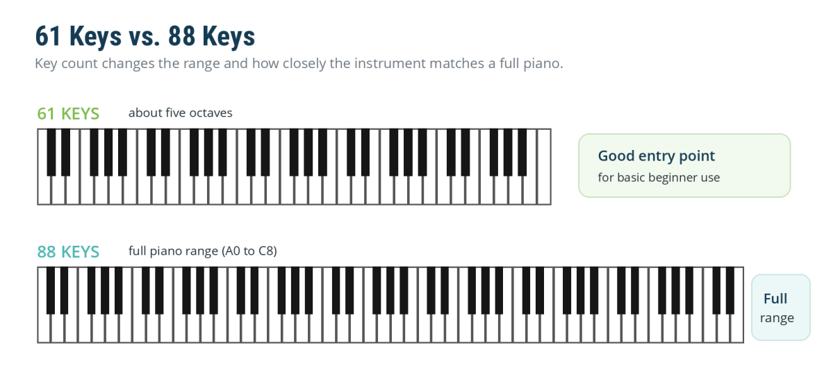
- Number of keys: 61 keys cover about five octaves; 88 keys give you the full range of a real piano (A0 to C8).
- Weighted vs. semi-weighted vs. unweighted: weighted action feels closest to a real piano and builds proper technique from day one.
- Touch sensitivity: lets the instrument play louder or softer depending on how hard you press a key.
- Extra features: a sustain pedal input, a built-in metronome, and Bluetooth or MIDI so you can connect learning apps.
Skip the urge to chase the fanciest model on the shelf. Nail these basics first, and everything else is just a bonus.
How to Learn Piano: Comparing Your Options
Once you’ve got an instrument, the next question is how you’ll actually build the skill.
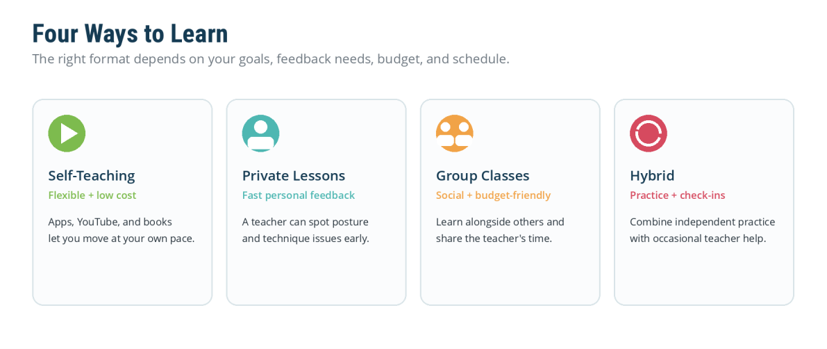
Self-Teaching with Apps and YouTube
Self-teaching costs little and lets you move at your own pace. Free apps and YouTube channels make it easy to try piano before committing to anything bigger.
The catch is that no one’s there to catch bad habits early. Small mistakes in hand position or posture can quietly turn into hard-to-break patterns over time.
Private Piano Lessons
A real teacher gives you fast, personal feedback. A trained eye can spot a problem in seconds that might take you months to notice on your own.
Online and in-person lessons both work well for most learners, and online options often run cheaper. In-person still holds a slight edge for young kids and anyone who benefits from hands-on posture correction.
Looking for professional instruction? United Conservatory of Music & Arts offers personalized private piano lessons for all skill levels, matching you with the perfect instructor to help you progress quickly.
Group Classes
Group classes typically run well over 50% cheaper than private lessons, since you’re splitting the teacher’s time with other students. That savings comes with a real social bonus, too.
They work especially well for kids and adults who enjoy learning alongside others rather than one-on-one.
If you thrive in a collaborative environment, explore our group piano classes at United Conservatory of Music & Arts to learn alongside fellow aspiring pianists.
Hybrid Approaches
Many learners mix daily practice on an app or method book with occasional check-ins from a teacher. It’s an increasingly common way for busy adults to stay consistent without a huge time commitment.
What to Expect on Your Piano Journey
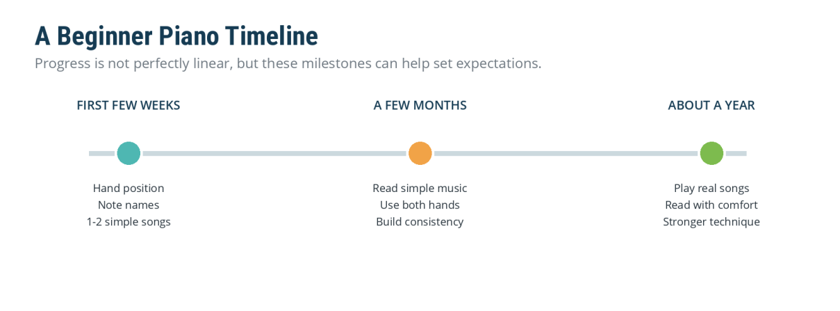
Your first few weeks will focus on hand position, note names, and one or two simple songs. Feeling stuck sometimes is completely normal, not a sign you’re doing something wrong.
By a few months in, most beginners can read simple sheet music and use both hands together. Progress won’t feel like a straight line, and that’s okay.
Give it about a year of steady practice, and many beginners can play real songs and read music with genuine comfort. Everyone’s timeline looks a little different, so don’t compare your week three to someone else’s month six.
Setting Up Your Practice Space and Routine
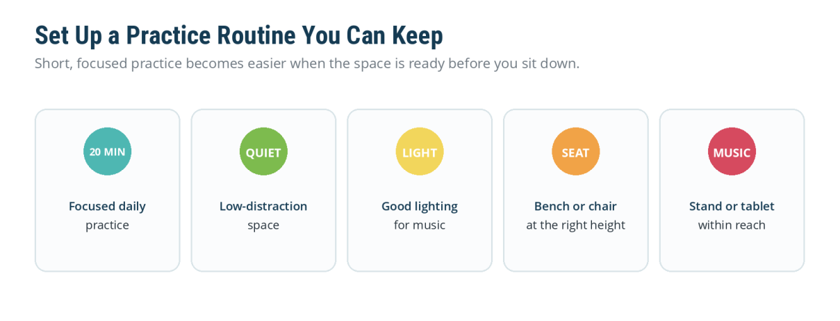
How you practice matters more than how long you practice. Short, daily sessions consistently beat one long session squeezed in once a week—even 20 focused minutes a day adds up fast.
Set up your practice spot somewhere quiet, with good lighting and a bench or chair at the right height. Keep a music stand or tablet close by so you’re never fumbling for sheet music mid-song.
A few common mistakes trip up almost every beginner at some point:
- Skipping proper hand posture
- Avoiding music theory completely
- Comparing your progress to someone else’s
- Practicing so long in one sitting that you burn out
None of these are permanent. Most beginners make at least one of them early on, and every one is easy to fix once you notice it.
What Piano Lessons Typically Cost
Three things drive the price of learning piano: your instrument, your lesson format, and any extra materials along the way.
- Instrument: basic keyboards start cheap, digital pianos cost more, and acoustic pianos sit at the top of the range once you factor in ongoing tuning care.
- Lesson format: Private in-person lessons generally cost more than online private lessons, while group lessons are typically the most budget-friendly option. Many teachers also offer monthly lesson packages instead of individual sessions.
- Materials: method books and sheet music add a small cost each year—nowhere near what you’ll spend on the instrument itself.
There’s no universal “right” budget here. It depends entirely on the instrument path you chose earlier in this guide.
If cost is your biggest concern, group lessons or a self-teaching app paired with occasional private check-ins usually stretches your budget the furthest without slowing your progress.
At United Conservatory of Music & Arts, we offer a variety of flexible and affordable piano lesson packages tailored to your goals. Reach out today to discuss our rates and find a plan that works for you.
Conclusion
There’s no single right way to learn piano. The best instrument, method, and pace depend on you—your budget, your goals, and how much time you can realistically give it each week.
Use this guide as your map. Once you know your starting point, dive into the next step, and let it take you further than a general overview ever could.
Ready for real, hands-on guidance instead of going it alone? United Conservatory of Music & Arts offers piano lessons for every age and skill level, from your very first lesson to your first recital. Reach out today to find a lesson plan built around you.
Ready to Start Piano Lessons?
United Conservatory of Music & Arts offers personalized piano lessons built around your goals and your pace.
Call 559-249-2851Enroll Today
Disclaimer: This guide is intended for general educational and informational purposes only. Learning timelines, costs, and practice recommendations will vary based on individual ability, instrument quality, and consistency of practice. This content is not a substitute for personalized guidance from a qualified piano teacher.
